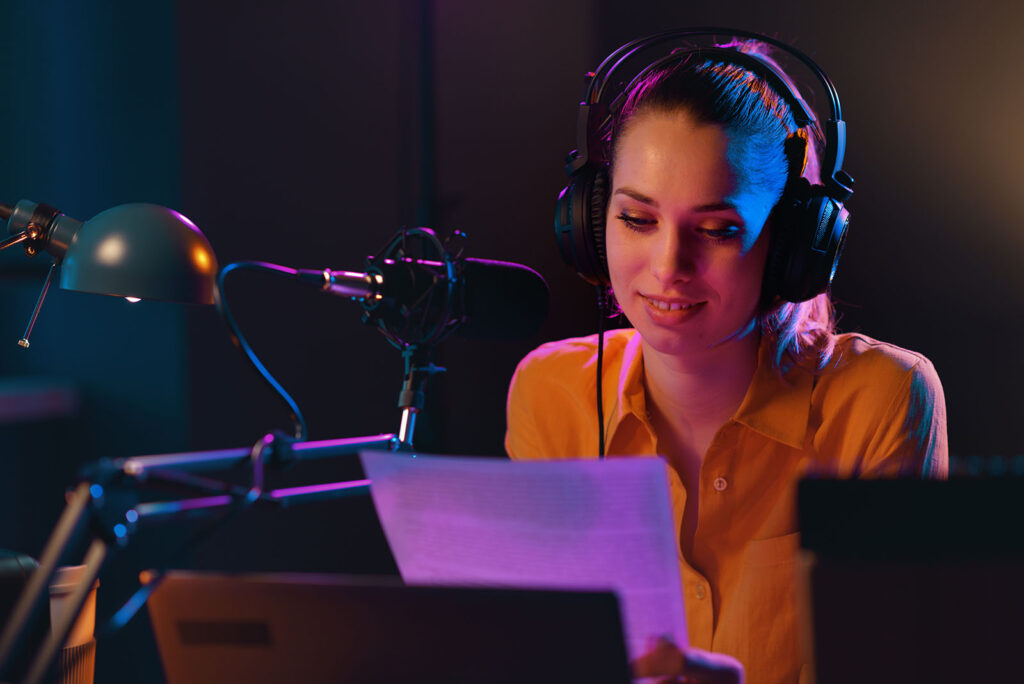
Audiobooks are the fastest-growing format in publishing, and listeners aren’t just consuming more of them, they’re getting pickier about who’s reading them. Increasingly, the audiobooks that succeed are the ones voiced by the author.
If you’ve written a book, especially nonfiction, memoir, or something drawn from your own expertise, your voice is a huge asset. This guide covers what recording an audiobook actually involves for the author/reader: How long it takes, what it costs, what the technical requirements are, and how to decide whether to narrate it yourself.
I’m the co-founder of Record ATX in Austin, where we record audiobooks alongside podcasts, video, course content and more. I’ll use our process as the concrete example throughout this guide.
Why your voice matters
If the book is your story or your expertise, I recommend narrating it yourself. Your voice carries a credibility no hired reader can borrow. Professional narrators are great, and for fiction they’re often the better call. But if your book is your story or your expertise, nobody delivers it like you do. And, in my experience, more people will want to listen to your audiobook if you, the writer, narrates it, especially for nonfiction books.
Recording an audiobook: the process
Here’s the part most first-time authors underestimate, and I’d rather you plan for it than discover it later.
- Finished hours. Audiobooks are measured in finished hours of final audio. Here’s a rough conversion: About 9,000–10,000 words per finished hour. So a 60,000-word book is roughly 6–7 finished hours.
- Studio recording hours. You don’t record a finished hour in an hour. Between restarts, water breaks, and fixing flubbed lines, most narrators need two to three hours of studio time per finished hour. That same 60,000-word book is realistically 15–20 hours in the studio.
- Sessions, not a marathon. Voices get tired, and a tired voice is audible. Most authors record in 2–4 hour blocks across several days or weeks. Consistency of sound matters. The best sounding audiobooks use the same room, same mic, same recording techniques every time the record button is hit. This is the best argument for recording the entirety of your audiobook in one studio rather than piecing it together at home or from different random recordings
- The post-production. Editing, proofing against the manuscript, mastering to distributor spec. This is typically the longest phase and it’s not one you want to do yourself. Our studio takes care of all of this for you to deliver an audiobook that’s ready to publish on Audible, Apple Books, and all audiobook platforms.
What it costs
Audiobook production is priced by the project. At Record ATX, we scope audiobooks individually. We’ll look at your word count then give you a project quote for hours to schedule in studio before you book. Reach out for a fast quote.
Here are things that affect the hours: The total word count of the book, how experienced you are at reading aloud (first-timers typically need more takes, which is completely normal).
The technical requirements nobody warns you about
Audiobook distributors like Audible/ACX, Findaway, Apple Books, and the rest enforce strict technical standards like consistent volume levels across the whole book, a quiet noise floor, specific file formats, room tone at the head and tail of each chapter, and one file per chapter named to spec. Books get rejected for failing these, sometimes after the author has recorded the entire thing.
This is the single strongest argument for recording in a professional studio rather than at home. A treated room, a proper mic chain, and an engineer who has delivered to these specs before means the technical compliance is handled while you focus on reading. At our studio, you narrate; we deliver professional audio files that meet distributor requirements.
Should you narrate it yourself?
Narrate it yourself if:
- It’s nonfiction, a memoir, or about your expertise.
- Your readers know you from a podcast, the stage, your industry, or social media.
- You can commit to the recording session hours; and you’re willing to be coached (the reading voice is a learnable skill, not a talent you either have or don’t).
Hire a narrator if:
- It’s fiction with multiple characters, accents, or dialogue-heavy scenes.
- You physically can’t commit to the time needed to record.
- Not sure? Record a chapter. It’s a couple of hours and it answers the question definitively.
How to prepare
- Protect your voice. Hydrate the day before, not just during the recording. Skip dairy and caffeine before sessions. Drink room-temperature water.
- Let yourself be coached. Most first-time narrators read too fast and drop energy at the ends of sentences. Both are easy fixes when someone in the room catches them in real time.
- Don’t worry too much about mistakes. Pause, breathe, and pick up from the start of the sentence. The edit makes it invisible. This is the single technique that speeds up a session most.
For book publishers and imprints
If you’re producing multiple audiobook titles, the constraints can change. You need scheduling reliability, consistent sound across a catalog, files that pass distributor QC the first time, and a studio that can slot in a narrator’s booked hours without a problem.
We work with publishing teams on multi-title productions Our audiobook studio can hold sessions across a slate without bottlenecking, our engineers deliver to distributor spec, and we can handle all of the post-production to deliver your audiobook to spec. If you’re evaluating Austin studios for a list of titles, reach out and we’ll talk through scheduling and pricing.
FAQ
- How long does it take to record an audiobook? Expect two to three hours of studio time per finished hour of audio. A 60,000-word book is roughly 6–7 finished hours, so 15–20 hours in the studio, usually spread across several sessions.
- Can I narrate my own audiobook? Yes, and for nonfiction, memoir, and expertise-driven books it’s often the better choice. Your voice carries authority and familiarity a narrator can’t replicate. (Fiction with heavy dialogue is where professional narrators typically outperform authors.)
- How much does it cost to record an audiobook? Audiobook production is quoted per project rather than hourly, since the hours depend on book length and narration experience. At Record ATX we scope each book individually and quote a flat rate before you book. Get in touch for a fast quote.
- Do audiobooks have technical requirements? Yes. Distributors like Audible/ACX enforce standards for volume consistency, noise floor, file format, room tone, and chapter file structure. Books that fail these get rejected, which is why recording in a professional studio with an engineer matters.
- Can I record an audiobook in a home studio? Some authors do, but meeting distributor technical standards from an untreated room is difficult, and discovering a problem after recording an entire book is expensive in time. Plus, post-production can be an intense hurdle when trying to meet audiobook distributor technical standards. A treated studio with an experienced staff removes risk and delivers the best product.
- How do I prepare to narrate my book? We recommend building a pronunciation list for names and technical terms, hydrate the day before, and plan for multiple sessions rather than one marathon session.